
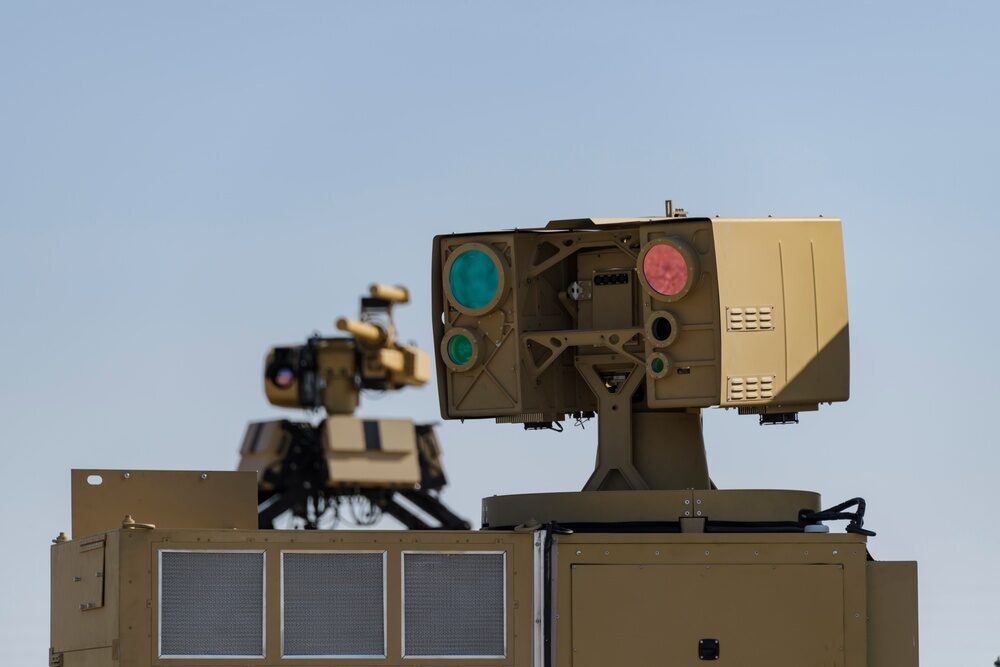
Most counter-UAS programs force an operator into a binary choice: soft-kill the drone with electronic warfare, or commit to a hard-kill effector. Rohde & Schwarz and TRUMPF are proposing a third approach — build the choice into the doctrine, wire it into one command-and-control stack, and let the threat determine which rung of the ladder gets used. That engineering proposition, formalized as the Tactical High-Energy Opponent Response & Interception System, or THORIS, was put in front of the European defense market at ILA Berlin 2026 on June 10.
The concept is an escalation ladder compressed into a single integrated platform. When a drone is detected, the system's first response — where operationally feasible and where legal frameworks permit — is jamming. RF jamming remains the fastest, cheapest, and most reversible way to neutralize a radio-controlled drone, and it carries no kinetic risk to the surrounding environment. Only when jamming is ineffective, legally constrained, or tactically inappropriate does THORIS escalate to its laser combat system, the THORIS LCS effector. The laser delivers what the partners describe as controllable high-power pulses, targeting either the drone's control electronics or its propulsion. The effect is disabling rather than explosive — no fragmentation, no kinetic debris field — which matters enormously for C-UAS systems deployed near populated infrastructure or in complex urban airspace.
Target acquisition, once the sensor suite has a fix, occurs within milliseconds. The detection architecture is layered: RF detection handles radio-controlled drones, radar covers the broader airspace picture, and EO/IR sensors extend tracking to platforms with minimal or no radio-frequency signatures — the autonomous or encrypted drones that pure-RF defenses cannot reliably catch. Pulling that multi-modal sensor picture into a unified C2 stack, rather than bolting heterogeneous systems together at the integration layer, is the architectural argument Rohde & Schwarz is making.
Why This Pairing
Rohde & Schwarz is a logical architect for the RF and C2 side of this system. The German firm has built its defense portfolio around electronic warfare, signals intelligence, and communications — the exact competencies required to field a detection stack that spans RF-passive, radar, and EO/IR modes and fuses them coherently. What it does not have in-house is a high-energy laser source. That gap is filled by TRUMPF, the German industrial laser manufacturer whose products already underpin precision manufacturing at scale. Industrial laser technology has long been ahead of military laser programs on raw beam quality and reliability — the challenge has been ruggedizing it for field deployment. TRUMPF's involvement suggests the partnership is building on proven laser hardware rather than developing an entirely novel weapon-grade source from scratch.
The modular architecture reflects a deliberate market positioning. THORIS is designed for both vehicle-mounted mobile deployment — convoy protection, forward operating bases, maneuver forces — and fixed installation for critical infrastructure defense, the kind of point-defense role that has become a standing requirement across European NATO members. A single product line that serves both use cases simplifies procurement arguments and logistics chains, and positions the system for both military and dual-use civil security customers.
What the Specifications Don't Say
The ILA Berlin announcement was a full-scale mock-up showing, not a capability demonstration with disclosed performance data. Two figures conspicuously absent from every source covering the unveiling: the laser's output power in kilowatts, and the system's effective engagement range. Neither has been disclosed.
Those omissions are not unusual at this stage — directed-energy programs routinely withhold the numbers that would allow direct competitive benchmarking until much later in the development cycle — but they make it impossible to place THORIS on the performance spectrum that separates low-power laser dazzlers from genuine hard-kill systems. The phrase \"high-energy\" in the system's full name, and TRUMPF's industrial laser heritage, suggest serious ambitions on power output, but the operational envelope remains unconfirmed.
What is confirmed: full integrated vehicle system market introduction is planned for the end of 2028. Demonstrators are underway and validation work is in progress. That timeline puts THORIS roughly two and a half years from a fielded product, which is aggressive for a system combining novel sensor fusion with a new-generation laser effector, but not implausible if the underlying subsystems — TRUMPF's laser, R&S's EW and C2 — are already at high maturity levels independently.
Rohde & Schwarz frames THORIS as a sovereign counter-UAS capability, a phrase that carries specific weight in the current European procurement environment, where dependence on non-European C-UAS systems has become a political liability and several NATO members are explicitly prioritizing industrial base arguments alongside raw performance.
The Field THORIS Is Entering
The European directed-energy counter-drone sector is compressing fast. The same week THORIS was unveiled at ILA Berlin, Israel's Esh-Tech debuted its DroneLight laser C-UAS system just days before the German show opened. MBDA Germany has reportedly shown a laser and missile hybrid concept at the same show. The geography of that competition matters: German sovereignty arguments, NATO interoperability requirements, and the post-2022 European defense spending surge are all pulling in the direction of European-made solutions, and both Rohde & Schwarz and TRUMPF have the industrial credibility and export profiles to compete across that market.
The harder competitive question is timing. A late-2028 market entry means THORIS will arrive in a field where rival directed-energy systems — including the ones shown at the same air show — will have had two additional years to mature, demonstrate, and win early contracts. The escalation-ladder architecture, a genuinely differentiated engineering proposition if the C2 integration is as seamless as the partners are implying, may be the clearest argument the program has for that comparison. Until Rohde & Schwarz and TRUMPF put power and range figures on the table, the architecture is the product.
Sources
- Rohde & Schwarz — Rohde & Schwarz and TRUMPF advance laser-based drone defense with THORIS LCS (press release)
- EDR Magazine — Rohde & Schwarz and TRUMPF Advance Laser-Based Drone Defense with THORIS LCS
- Defence Industry Europe — THORIS LCS Laser-Based Counter-UAS System for Mobile and Fixed Defence
- Joint Forces News — Rohde & Schwarz Announces THORIS LCS
- Aviation Week — Rohde & Schwarz Enters Laser C-UAS Race
- ESUT — ILA Berlin 2026: Rohde & Schwarz und TRUMPF präsentieren THORIS LCS