
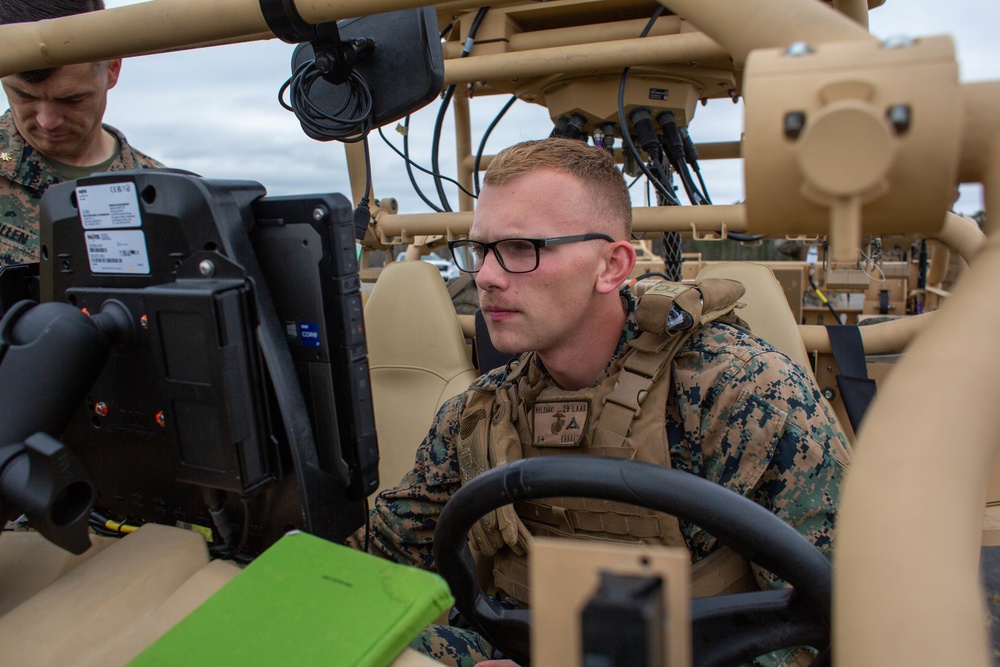
Directed energy has spent the better part of a decade stuck in the demo phase — impressive at test ranges, perpetually one budget cycle away from the field. The Marine Corps just nudged one system across that line. According to an August 10 report from DefenseScoop, Epirus says the Marine Corps has awarded it roughly $11 million for HAVOC — the High-power Microwave Autonomous Vehicle Operation Capability — an autonomy-enabled evolution of the ExDECS high-power microwave prototype the company delivered to the Marines in spring 2026. (The Marine Corps did not respond to DefenseScoop's inquiries about the award.)
The award covers the system itself plus testing, training and support. That last part matters: it is the difference between buying a science project and buying something a unit is expected to operate. And the design choices Epirus made suggest the Marines intend to actually bolt this thing onto things that move.
HAVOC rides on a universal sled mount that attaches to a variety of vehicles, and it is designed to fight alongside the Marine Air Defense Integrated System (MADIS), the Corps' vehicle-mounted short-range air defense suite. Rather than standing up yet another bespoke counter-drone stovepipe, the Marines are slotting a microwave weapon into an air-defense architecture they are already fielding.
There is another detail in the DefenseScoop report that separates HAVOC from the usual prototype-of-the-week announcement: a variant of the system has already completed three operational assessments overseas with the Army, in both the CENTCOM and Indo-Pacific regions. Whatever HAVOC is, it is not a viewgraph.
From Leonidas to ExDECS to HAVOC
The lineage here is worth tracing, because it shows a deliberate pipeline rather than a one-off buy.
The story starts with Leonidas Expeditionary, formally designated ExDECS — the Expeditionary Directed Energy Counter-Swarm system — announced in September 2024 as a partnership between Epirus, the Office of Naval Research, the Marine Corps Warfighting Lab and the Joint Counter-small UAS Office. As Marine Corps Times reported at the time, the system uses long-pulse electromagnetic energy to disable drones, is transportable with a low physical signature, and is built on a scalable architecture of Line Replaceable Amplifier Modules — components an Epirus spokesperson, Andrew Wargofchik, memorably described as "very scalable Lego blocks." Delivery to the Marine Corps Warfighting Lab was expected by the end of 2024.
By April 2025, Epirus announced it had delivered the ExDECS prototype to Naval Surface Warfare Center Dahlgren Division after completing Factory and Government Acceptance Testing. The mobile, solid-state HPM system — derived from the company's Leonidas Expeditionary line — arrived under an initial Office of Naval Research contract, with a September 2024 follow-on for further testing under the PEGASUS program. The point of the exercise was Marine experimentation for Low Altitude Air Defense (LAAD) and Ground Based Air Defense (GBAD) missions. "Systems like ExDECS give Marines a decisive advantage by neutralizing multiple electronic threats at once with a single system," Epirus CEO Andy Lowery said at the time.
That is the core sales pitch for high-power microwaves generally: where a missile or a gun engages one target at a time, an HPM system fries electronics across a volume of airspace. Against a coordinated swarm — the scenario that keeps air defenders up at night — that one-versus-many math is the whole game.
HAVOC is what happens when that experimental prototype gets an autonomy layer and a procurement decision. DefenseScoop does not detail what the autonomy layer actually does, but the "Autonomous Vehicle Operation" in the name points at where the Marines appear to want this to go: a microwave weapon mounted on whatever vehicle is available, operating as part of a layered defense rather than as a standalone curiosity.
A Company Betting on Production, Not Prototypes
The most telling quotes in the DefenseScoop report are not about the technology — they are about the factory floor. "We have the capacity to get up to about one system per week already, today," Lowery told the outlet, adding that the company has facilities prepared for low-rate production.
One system per week is not mass production by munitions standards, but for directed energy it is a statement of intent. The historical failure mode for HPM and laser programs has not been physics; it has been the transition from hand-built demonstrator to repeatable manufacturing. A vendor pre-positioning production capacity before the big program-of-record order arrives is making a bet that the order is coming.
Epirus is not betting only on the Marines. The company is pursuing Army contracts and international sales, per DefenseScoop — and the three overseas operational assessments with the Army in CENTCOM and the Indo-Pacific suggest that pursuit is further along than a pitch deck.
Why It Matters
The economics of counter-UAS are broken, and everyone in the Pentagon knows it. Cheap attack drones — the Iranian Shahed-type one-way attackers now proliferating across multiple theaters — cost a small fraction of the interceptors used to shoot them down. Officials are eyeing high-power microwaves and lasers as low-cost, "low-collateral" options precisely because the marginal cost of an engagement is measured in electricity rather than in expended missiles, DefenseScoop notes.
HAVOC is a data point suggesting the directed-energy portion of that answer is finally maturing. The signals are all pointing the same direction: a prototype that graduated to a paid award covering training and sustainment, not just hardware; a design that integrates with MADIS instead of competing with it; a variant already through three operational assessments in the two theaters that matter most; and a vendor with a production line warm and waiting.
An $11 million award is small money in air-defense terms. But program offices do not pay for testing, training and support on systems they intend to leave in a warehouse. For the counter-UAS world, the significance is less the dollar figure than the trajectory — ONR science project in 2024, Dahlgren delivery in 2025, Marine hands and an autonomy-enabled follow-on by 2026. If the Army and international interest converts, the question shifts from whether microwave weapons work to how fast Epirus can build them. By the CEO's own account, the answer today is about one per week — and counting.
Sources
- Marine Corps awards Epirus $11M for high-powered microwave program, company says — DefenseScoop, Aug 10, 2026
- Epirus Delivers ExDECS HPM Prototype to U.S. Navy for Marine Corps Counter-Drone Swarm Capability — Epirus press release
- Marines to receive new system for zapping drone swarms out of the sky — C4ISRNET/Marine Corps Times, Sep 30, 2024