
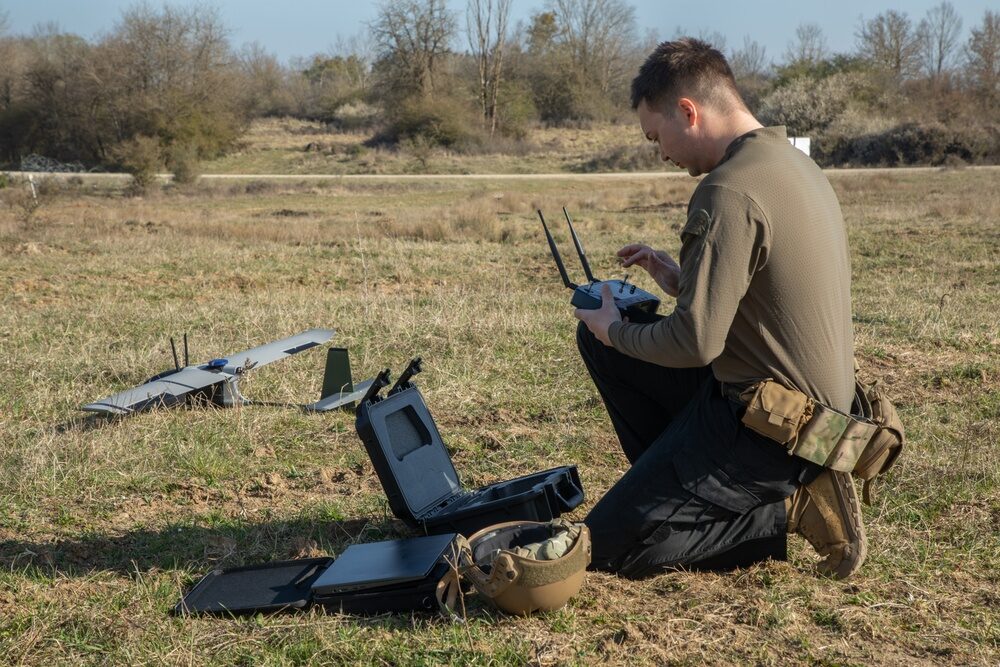
The working assumption inside the US small-UAS industrial base has shifted. Drone makers that treated communications as a bolt-on subsystem — someone else's radio, someone else's firmware — are running out of runway as the Army's operational requirements increasingly center on electromagnetic survivability. Performance Drone Works signed a definitive agreement on June 4 to acquire Vanteon Corporation, a Rochester, New York engineering firm with four decades of RF design, software-defined radio, and embedded systems work. The financial terms were not disclosed; the deal is expected to close pending customary conditions.
The logic is vertical integration driven by threat reality, not product diversification. PDW and Vanteon had already been working together on contested and adverse radio condition technology. Buying that capability outright removes a dependency at exactly the moment the Army has made electromagnetic survivability a program requirement rather than a desired feature. As PDW CEO James Slider put it:
"In future operations, being able to function in contested environments is table stakes."
That framing matters. Table stakes means not a differentiator — a floor. Any serious military drone supplier that cannot demonstrate resilient communications in a GPS-denied, jammed, or spoofed environment is simply not competing for the contracts that matter. Vanteon's roughly 40 engineers — specialists in RF design, SDR, and mission-critical hardware/software integration — move from external collaborator to internal capability, giving PDW's product development cycle direct access to the radio stack rather than a vendor relationship with its attendant lead times and IP boundaries.
Vanteon's Profile and the Prior Collaboration
Vanteon has operated for more than 40 years, long enough that its institutional knowledge predates the software-defined radio era entirely — the firm evolved through it. That depth is the acquisition's real asset. SDR expertise is not easily hired; it accumulates through programs, field feedback, and hard lessons about what breaks under operational conditions. The prior collaboration gave PDW early visibility into how Vanteon approaches communications resilience, which de-risked the cultural and technical integration calculus considerably.
The operator-first framing both companies use is consistent with how PDW positions its full product line — C100 quadcopter for ISR, the AM/Attritable Multirotor for strike missions, the CORE mission planning software — each designed around the practical constraints of the dismounted soldier rather than the test range.
The Production Platform Behind the Deal
Understanding why Vanteon's RF engineering matters to PDW specifically requires the scale context. PDW's Drone Factory 01 sits in Cummings Research Park in Huntsville — 90,000 square feet with stated annual capacity of up to 100,000 NDAA-compliant systems. Monthly throughput figures the company has cited: up to 350 C100s and 5,000 AM-FPVs. Those are production numbers, not prototype numbers. At that volume, a communications subsystem sourced from an external vendor creates a supply chain exposure that compounds as throughput scales.
The March 2026 Series B underlined PDW's production-first positioning. The company raised $110 million, led by Ondas Holdings, with co-investment from Hood River, Cedar Pine, Hanwha Asset Management's venture fund, and Booz Allen Hamilton. Houlihan Lokey advised on the Series B; Wilson Sonsini is representing PDW on the Vanteon transaction, with Harris Beach Murtha advising Vanteon.
The Army validation came earlier. PDW's most recent Army contract — $15 million for C100 systems and Multi-Mission Payloads — put its platforms in front of formations that must operate in exactly the threat environments the Vanteon engineering addresses. That contract context makes the Vanteon acquisition read less as a strategic hedge and more as a necessary step to hold the ground PDW has already taken.
What RF Vertical Integration Means for the Industrial Base
The US defense drone sector has spent several years working through the NDAA-compliance problem — removing Chinese-sourced components from supply chains — but the next constraint is becoming visible: full-stack electronic warfare and communications competence. Airframe manufacturing, battery sourcing, and camera supply chains are increasingly domesticated. RF and SDR engineering remains thin. The number of US firms that can design, test, and manufacture resilient radio systems for the operational environments the Army is now describing is small, and the talent pipeline is not deep.
PDW folding Vanteon in-house concentrates that capability inside a company that has demonstrated both production discipline and a direct Army customer relationship. The implications run in both directions. For PDW, it accelerates a roadmap in which, as Slider frames it, resilient communications and spectrum awareness only grow in importance as autonomy evolves. For the broader industrial base, it signals that the competition for the next generation of military small UAS contracts will be settled at the full-stack level — airframe, autonomy, and RF/EW together — not on any single component. Vendors that cannot integrate those layers, or that depend on external RF suppliers, face a structural disadvantage against a production-scaled competitor that now owns its radio shop.
Sources
- PR Newswire — PDW Announces Agreement to Acquire Vanteon, Expanding Communications Expertise and Engineering Capacity
- DRONELIFE — PDW Drone Communications Resilience: Vanteon Acquisition
- Huntsville Business Journal — PDW to Acquire New York Communications Engineering Company
- PR Newswire — PDW Raises Over $110M in Series B Financing