
For two decades, the directed-energy business has run on a loop: a promising demonstration, a glowing press release, a prototype contract — and then silence, as the program quietly stalled short of production. This week, that loop may finally have broken. Bloomberg reported on August 7 that the U.S. Army will buy at least $400 million worth of AeroVironment's Locust high-energy laser systems, a deal described as the Pentagon's first production agreement for a directed-energy counter-drone system beyond the prototype phase.
The distinction matters more than the dollar figure. The Defense Department has funded laser weapons research since the Reagan era and fielded a steady procession of testbeds, technology demonstrators, and "operational prototypes." What it has never done — until now — is commit to buying a counter-drone laser in quantity as a production program. According to the reporting, the Army will receive dozens of Locust systems under the agreement, converting a technology that has lived in the S&T budget into a recurring line item.
Wall Street noticed. AeroVironment shares jumped on the report — up 9.12 percent by Investing.com's count, roughly 8 percent per Yahoo Finance's coverage — a meaningful pop for a stock that remains down about 27 percent for the year. Retail sentiment on Stocktwits flipped from bearish to neutral within 24 hours, even as message volume stayed low.
From BlueHalo Science Project to Army Product Line
Locust did not start life as an AeroVironment product. The system originated with BlueHalo, the defense technology firm AeroVironment later acquired — a deal that, in hindsight, looks like the pivotal move in AV's transformation from a small-drone maker into a diversified defense prime. Locust uses AI to track and identify small-to-medium drones, then assists human operators in destroying them with a high-energy laser — a sensing-and-fire-control package as much as a beam.
The system's operational résumé is unusually deep for a laser weapon. The Army's Palletized High Energy Laser (P-HEL), a 20-kilowatt system based on Locust, went to sea aboard the aircraft carrier USS George H.W. Bush in October 2025, where it engaged 17 drones in a live-fire demonstration, according to an AeroVironment executive. Navy appetite for that kind of packaging is on the record: Chief of Naval Operations Adm. Daryl Caudle told a defense industry conference in March, "I want to containerize everything."
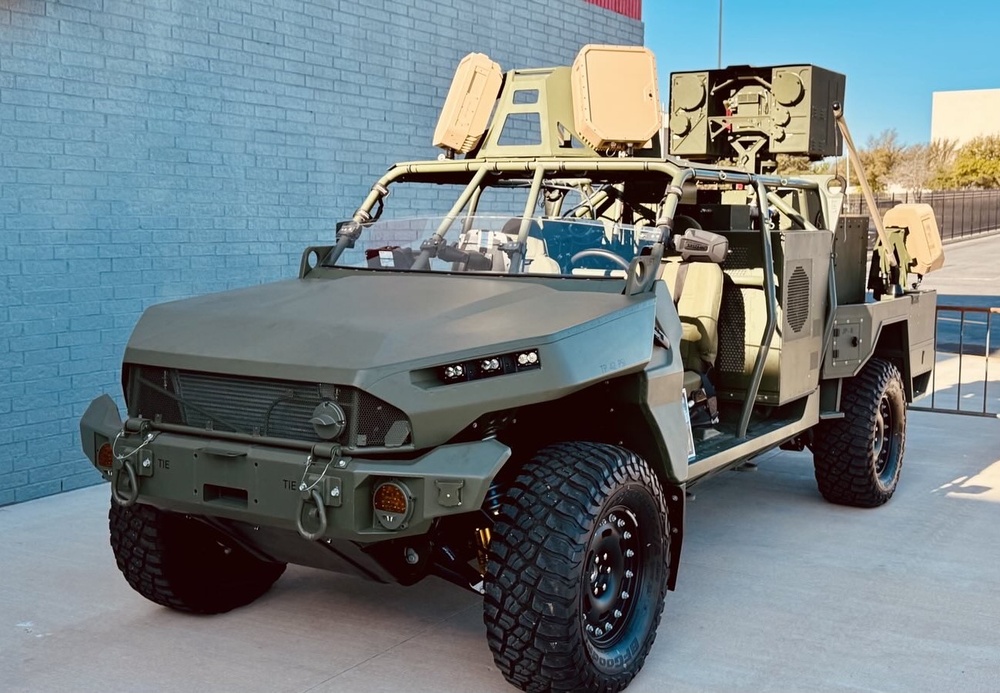
On land, Locust has been integrated onto M1301 Infantry Squad Vehicles and Joint Light Tactical Vehicles, with at least four systems fielded under an Army initiative called AMP-HEL. The system's track record also includes one of the more memorable footnotes in counter-UAS testing: during earlier trials near the Mexico border, Locust inadvertently shot down a U.S. Customs and Border Protection drone — an incident that speaks simultaneously to the weapon's lethality and to the identification-and-deconfliction challenges that come with fielding it.
The Physics Still Has a Vote
None of this repeals the hard limits that have dogged laser weapons since their inception. High-energy lasers degrade in the atmosphere — water vapor, dust, and salt aerosols all sap beam power before it reaches the target, which is part of why the maritime environment is simultaneously the best and worst place to field them. And lasers have a dwell-time problem: each kill requires holding the beam on target long enough to do damage, which makes any single aperture vulnerable to saturation attacks by massed cheap drones — precisely the threat profile driving demand in the first place.
The counterargument, and the one the Army has evidently accepted, is that lasers don't need to be the whole answer. At an effectively unlimited magazine and a cost-per-shot measured in electricity, a 20-kilowatt-class laser that reliably kills small and medium drones takes pressure off finite interceptor stocks — even if kinetic effectors still handle the leakers and the swarms.
Why It Matters
For the directed-energy industry, this is the moment the business model changes. Prototype contracts pay engineering bills; production contracts build product lines, supply chains, and sustainment tails. A $400 million commitment for dozens of systems gives AeroVironment — and, by extension, its component suppliers — the demand signal needed to invest in manufacturing capacity rather than one-off integration labs. It also validates the BlueHalo acquisition as the source of AV's next franchise product, at a moment when the company's stock had spent the year under pressure.
For the Army, the production buy is a bet that the counter-drone fight is now permanent infrastructure, not a contingency — a commitment to fielding directed energy at the scale the technology can actually deliver today. If dozens of Locust systems perform in the field the way P-HEL performed off the deck of the George H.W. Bush, this $400 million looks like a floor, not a ceiling.
And for the broader market, the signal is simple: after decades as a perpetual technology of the future, a counter-drone laser is now something the Pentagon buys, not just tests. Every other directed-energy contender — and every air-defense planner weighing interceptor economics against drone swarm math — will be recalibrating accordingly.