
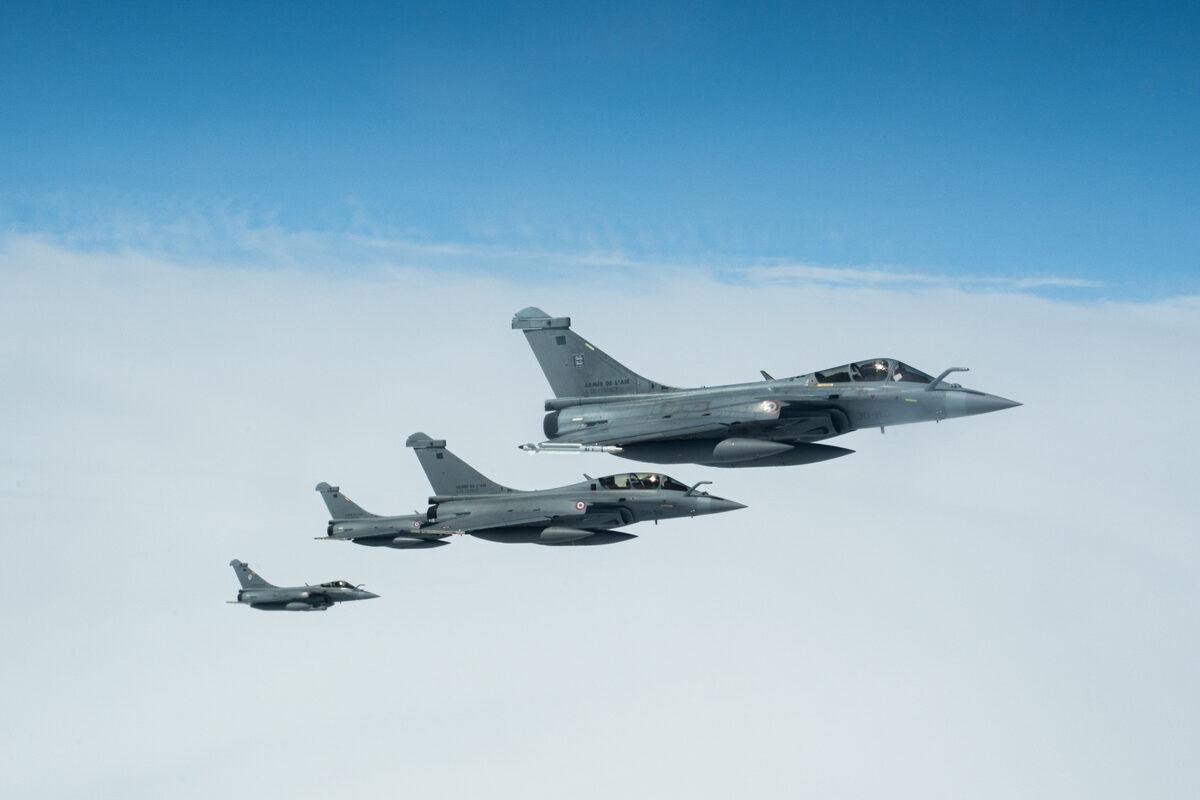
At approximately 15:38 local time on June 8, 2026, a Dassault Rafale assigned to NATO's Baltic Air Policing mission fired on and destroyed a drone above Bērzgale parish, in the Rēzekne municipality of Latvia's Latgale region — a stretch of low-lying forest and farmland pressed against the Russian and Belarusian borders. The jet launched from Šiauliai Air Base in Lithuania, supported by allied F-16s holding a wider cordon. Air-raid alerts covered five municipalities: Ludza, Balvi, Alūksne, Rēzekne, and Krāslava. The drone came down over uninhabited terrain; there were no casualties, no property damage.
On one point, Latvian authorities were clear. On everything else, they were not.
Attribution With Caveats
NATO and the Latvian government confirmed the shootdown quickly, but the drone's type and operator remain officially unconfirmed. Latvia's explanation for how it entered allied airspace points to Russian electromagnetic warfare — GPS jamming or spoofing techniques that have repeatedly knocked long-range Ukrainian strike drones off their programmed flight paths. The working assumption is that this was a war drone deflected by Russian EW, not an intentionally targeted NATO incursion.
"In Latvian airspace, over the Latgale region, fighter jets from the NATO Baltic Air Policing mission shot down a foreign unmanned aerial vehicle (drone) that had entered Latvia as a result of Russian electromagnetic warfare."
— National Armed Forces of Latvia, official statement
That framing matters legally and strategically. It means NATO intercepted a drone that is plausibly Ukrainian in origin, drifting through Latvian airspace because Russian jamming severed its navigational link — a scenario with no clean attribution and no obvious diplomatic escalation path. The Latvian armed forces reinforced air defense positions along the eastern border following the intercept and were direct about what the future holds: "As long as Russia's aggression in Ukraine continues, the recurrence of incidents where a foreign unmanned aerial vehicle enters or approaches Latvian airspace remains possible."
The debris will inform the type question eventually. Until then, the official posture is cautious certainty about the intercept itself and honest uncertainty about whose drone it was.
A Pattern Taking Shape Along the Flank
The June 8 intercept is not an isolated incident — it is the second confirmed NATO shootdown over allied territory in approximately three weeks. On May 19, a drone was shot down over Estonia, attributed to a Romanian F-16 in at least one account and described by other reporting as a Ukrainian drone. The same morning as the Latvia intercept, a separate drone came down in eastern Moldova; Chisinau's Foreign Ministry was blunt about assigning accountability: "Regardless of the drone's origin, responsibility for any drone that lands on the territory of the Republic of Moldova lies with Russia."
The surrounding weeks filled in an uglier picture. A Ukrainian drone struck a Rēzekne oil facility on May 7 — the same municipality where Sunday's intercept occurred. Russian drones exploded over Romania in late May, with one striking an apartment building and wounding two civilians. On May 20, a drone triggered air-raid alerts in Vilnius. Nordic-Baltic officials collectively described such incidents as "a direct consequence of Russia's illegal war."
Baltic and Nordic heads of state have been pressing for more than the current model can provide. The presidents of the Baltic states have called for enhanced air defense infrastructure that goes beyond what rotating air-policing fighters can realistically deliver. A Rafale can intercept a drone it is vectored onto; it cannot provide persistent, low-altitude coverage across hundreds of kilometers of border territory on a rotation schedule designed for a different era's threat.
Eastern Sentry and the C-UAS Procurement Push
The timing of the June 8 shootdown was pointed: it fell on the opening day of Ramstein Flag 2026, NATO's alliance-wide integrated air and missile defense exercise running June 8–18, which incorporates dedicated counter-UAS training. The exercise is itself a product of the doctrinal reorientation underway since autumn 2025, when NATO stood up Operation Eastern Sentry.
Eastern Sentry's stated purpose is explicit about the shift in frame. As Lieutenant Colonel "Thor" of NATO Allied Air Command put it: "Eastern Sentry is NATO's response and shift from an air policing mindset to an air defence mindset." The operation integrates NATO RQ-4D Phoenix remotely piloted aircraft based at Pirkkala Air Base in Finland, which conduct persistent surveillance over Norway and Finland — providing the kind of continuous domain awareness that short-rotation air policing cannot.
The doctrinal shift is now pushing into procurement, as the alliance works to systematize ground-based counter-drone capability along the flank rather than relying on fighters alone. That approach reflects a recognition that the eastern flank's drone threat is not episodic but structural: stray war drones, spoofed by Russian EW, will continue crossing into NATO airspace as long as the conflict continues, and air-policing fighters are a last resort, not a primary defense layer.
What the June 8 shootdown and its predecessors have demonstrated is that the transition is already underway operationally, even if the procurement and infrastructure sides are still catching up. Latvian armed forces closed their statement without ambiguity: "The possible air threat has ended." For now.
Sources
- Latvian Ministry of Defence — Allied fighters shoot down foreign drone in Latvian airspace
- Unmanned Airspace — NATO shoots down drone in Latvian airspace
- AeroTime — NATO fighters shoot down drone over Latvia
- CBS News — Latvia drone shot down by NATO
- GlobalSecurity.org — NATO Allied Air Command release (June 4, 2026)
- Defence Industry Europe — NATO's Eastern Sentry strengthens air defence posture on Eastern Flank