Taiwan's Ministry of National Defense has publicly committed to fielding tens of thousands of domestically produced drones. The ambition is not in doubt. The harder problem is the one that follows any fast-scaling multi-OEM fleet: every manufacturer ships its own ground control station, its own data links, its own operator workflow. At sufficient scale, that fragmentation stops being an inconvenience and becomes a force-multiplication problem — operators trained on one system can't immediately pick up another, logistics sprawls, software updates multiply, and the cognitive overhead of managing a heterogeneous fleet under pressure compounds quickly.
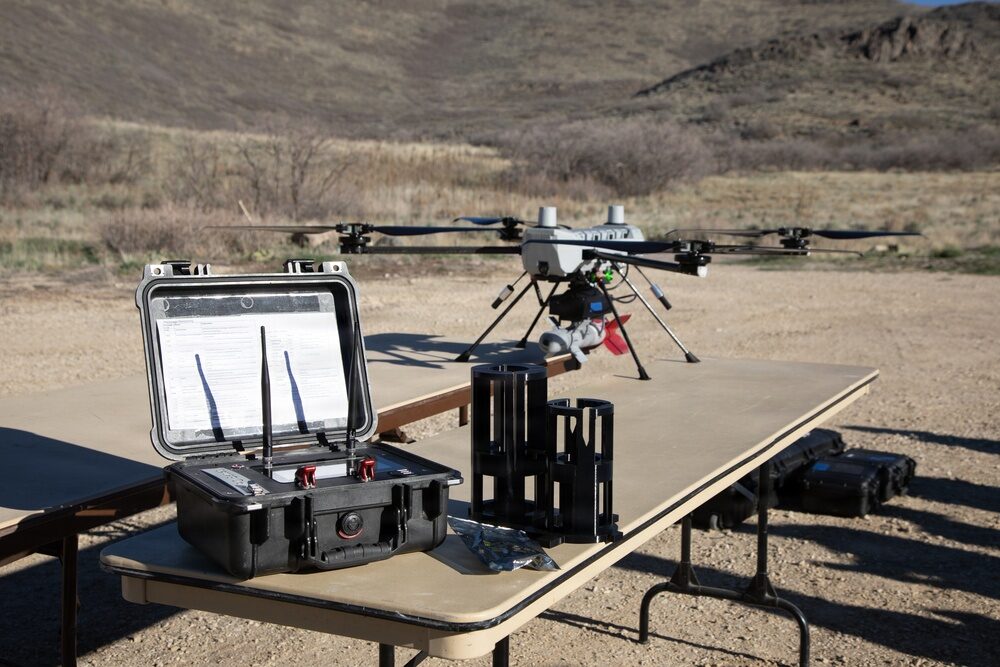
The MOU that AeroVironment (NASDAQ: AVAV) and Taiwan-based Ubiqconn Technology Inc. signed on June 11, 2026, is explicitly aimed at that problem. The agreement targets Taiwan MND requirements for the indigenous UAS program and centers on a concrete technical deliverable: AeroVironment's Kinesis mission management software, part of its AV_Halo COMMAND C2 suite, running on Ubiqconn's rugged controller hardware, creating a common interface capable of commanding multiple uncrewed aircraft types from multiple OEMs through a single scalable platform.
The Tomahawk Lineage Behind Kinesis
The technical substrate here matters. The common controller capability is built on AeroVironment's Tomahawk Common Control Ecosystem, with Kinesis functioning as a multi-platform, multi-domain C2 layer: a single operator interface able to address dissimilar uncrewed systems without retraining or hardware swaps for each new airframe.
That architectural ambition maps directly onto what Taiwan needs. When the MND talks about procuring tens of thousands of drones from a growing domestic industrial base, it is not talking about a single homogeneous fleet from one supplier. It is talking about a mix of OEM products — different airframes, different payloads, different flight envelopes — that still need to be operable by the same forces in the same fight. The common-controller layer is the part of the stack that makes that operationally feasible.
Under the MOU, AeroVironment will provide access to the KxM module — the hardware bridge that embeds Kinesis into external platforms — along with integrated training and technical support specifically for Ubiqconn's demonstrations to MND. The two companies also plan joint engagement with Taiwan's domestic drone OEMs, which is where the real test of the common-controller proposition will play out: whether manufacturers building for the MND program are willing to adopt a shared C2 interface standard rather than compete on proprietary controller ecosystems.
Ubiqconn's Role: The Hardware Credibility
Ubiqconn is not a drone OEM — it is a rugged computing and embedded systems company, founded in 2011 and headquartered in Taipei, with a customer base in defense and industrial applications. That specialization matters for this particular deal. The controller hardware layer in a high-tempo military UAS operation is a different engineering problem than the hardware inside the aircraft: it needs to survive field environments, support encrypted data links, handle multi-channel feeds, and do all of this in a form factor operators can actually carry and use under stress.
AeroVironment is bringing the software and the C2 doctrine; Ubiqconn is bringing the hardware platform that can credibly sit in front of Taiwan MND evaluators. The pairing is designed to present a complete solution — not a software demo running on a laptop — for the demonstration phase that precedes any procurement decision.
"Taiwan's defense and homeland security modernization requires a new standard of interoperability." — Paul Hsieh, CEO, Ubiqconn
That framing from Hsieh is precise. The word "standard" is doing real work: the pitch is not that Kinesis-on-Ubiqconn hardware is simply a better controller, but that it can become the baseline interoperability layer across a heterogeneous fleet. Whether the MND adopts it as a formal standard, or whether it becomes the de facto interface because enough OEMs integrate to it, the commercial outcome is similar — AV and Ubiqconn become load-bearing infrastructure for the Taiwan UAS program rather than one vendor among many.
The NCSIST Precedent and AV's Accumulating Footprint
This MOU does not arrive in a vacuum. In September 2025, AeroVironment signed a strategic collaboration agreement with Taiwan's National Chung-Shan Institute of Science and Technology (NCSIST) — the state-owned defense research organization that is the technical backbone of Taiwan's indigenous weapons programs and a primary interface between MND requirements and domestic industry. That agreement established AV's presence in the Taiwan defense ecosystem at the institutional level; the Ubiqconn MOU is a more specific commercial move within that relationship, targeting the controller hardware and software layer rather than the broader collaborative research frame of the NCSIST deal.
The sequencing is deliberate. A relationship with NCSIST provides visibility into MND requirements and access to the indigenous program's technical architecture. A follow-on MOU targeting a specific capability gap — controller interoperability — is the execution layer: a concrete product offering tied to a real procurement need that the institutional relationship helped surface.
AeroVironment's broader financials reinforce how aggressively the company has been expanding its defense business: recent financial data puts AV's revenue growth at 117% over the prior twelve months. That trajectory reflects demand across its uncrewed-systems portfolio, and it also reflects the kind of company-level credibility that matters when a foreign defense ministry is evaluating whether to build critical C2 infrastructure around a partner's software stack.
Nawabi's characterization of the deal maps to the longer-term play:
"By combining AV's battle-proven mission software with Ubiqconn's advanced rugged controller technology and Taiwan's growing industrial base, we're laying the groundwork for integrated, networked uncrewed solutions tailored to Taiwan's defense and security needs." — Wahid Nawabi, Chairman, President and CEO, AeroVironment
"Laying the groundwork" is the right description for where this sits. The MOU covers demonstrations and joint OEM engagement — there is no procurement contract announced, no fleet numbers attached to a signed agreement. What has been established is the technical pairing, the commercial relationship, and the access pathway to MND evaluation. For Taiwan's indigenous UAS program, which is trying to scale a domestically produced fleet fast enough to matter strategically, solving the controller fragmentation problem at the architecture level before the fleet gets large is considerably easier than retrofitting interoperability onto an already-fielded mix of incompatible systems. The window to set that standard is now, and that is what AeroVironment and Ubiqconn are positioned for.
Sources
- AeroVironment newsroom — AV Signs MOU with Taiwan's Ubiqconn to Develop Common Controller Ecosystem for Taiwan's Indigenous UAS Program
- Investing.com — AeroVironment Partners with Ubiqconn on Taiwan Drone Systems
- StockTitan / BusinessWire — AV Signs MOU with Taiwan's Ubiqconn to Develop Common Controller Ecosystem