
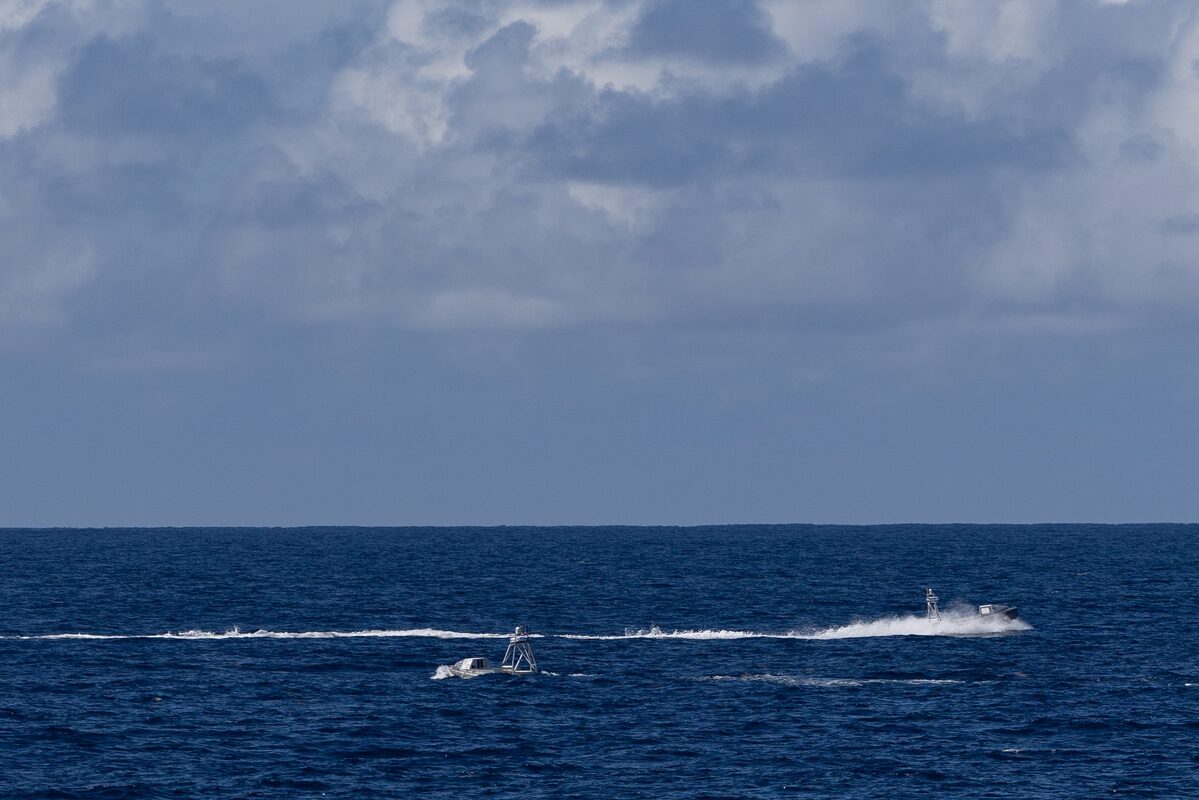
The uncrewed surface vessel that helped drive Russia's Black Sea Fleet into retreat is no longer just a bomb with a boat wrapped around it. According to a July 1, 2026 feature published jointly by C4ISRNET and Defense News, Ukraine's Security Service (SBU) has reworked its Sea Baby drone boat into something considerably more dangerous: a mobile launch platform that carries a swarm of first-person-view strike drones far out into the Black Sea and turns them loose from close range.
The conversion changes the arithmetic of the naval war. A one-way explosive USV can hit a ship. A USV that hauls six to eight FPV drones and a rack of thermobaric rockets can loiter, launch, and threaten targets its own hull could never reach — and it can do it hundreds of miles from the Ukrainian coast.
From kamikaze boat to mothership
In its original role, Sea Baby was a fast, low-profile surface drone packed with explosives and driven into Russian warships and infrastructure. The SBU develops and operates it; the platform is credited as part of the campaign that has sunk or damaged roughly a dozen Russian warships since 2022.
The new configuration keeps the boat's reach — a reported range of about 930 miles (1,500 km) while carrying a 4,400-pound payload — but repurposes that payload capacity. Instead of a single warhead, the vessel now stows six to eight FPV drones in side compartments, alongside thermobaric Shmel rockets. When Russian jamming cuts the operator's link, the boat leans on AI-assisted targeting and autonomy to keep working. Each Sea Baby costs a few hundred thousand dollars, according to the reporting — a figure that looks modest next to a frigate or a submarine.
The point of putting FPV drones on a boat is geometry. A shore-launched FPV has a limited radius. Launch that same drone from a hull sitting far offshore, and the effective strike envelope moves with the boat. Ukraine, in effect, has built a way to carry short-range precision weapons deep into contested water and fire them at the last mile.
Fiber optics beat the jammers
Electronic warfare is the defining problem of drone combat, and both sides pour enormous effort into jamming the radio links FPV drones depend on. The Defense News version of the feature notes that some of the FPVs carried by Sea Baby are fiber-optic-guided — physically tethered by a spool of hair-thin cable that pays out as the drone flies. A fiber link carries no radio signal to jam, which makes these drones effectively immune to electronic countermeasures.
That immunity matters at sea, where a warship's air-defense and EW suite is supposed to be the last line against small aerial threats. A fiber-guided FPV launched from a nearby USV sidesteps that defense entirely. The cumulative pressure, the reporting says, has forced Russia's Black Sea Fleet to pull its main operations back to Novorossiysk — the eastern end of the sea, and about as far from Ukraine as the Black Sea allows.
The Sub Sea Baby and a submarine that couldn't dive
Novorossiysk was supposed to be the safe harbor. It wasn't.
On December 15, 2025, a Ukrainian underwater drone dubbed "Sub Sea Baby" penetrated the port's defenses and struck a docked Kilo-class submarine, according to Naval News. Independent OSINT analysis by Militarnyi later identified the target as the diesel-electric submarine B-271 Kolpino. Naval News assessed that the damage would likely render the submarine inoperable for a serious period.
Analysts called the strike a likely landmark moment in naval warfare — described as the first uncrewed underwater attack on a submarine. Brig. Gen. Ivan Lukashevych of the SBU is quoted in the July feature discussing the service's naval drone work.
The symbolism is hard to miss. Submarines exist to be hard to find and harder to hit. An uncrewed underwater vehicle, built and expended at a fraction of a submarine's cost, reached one in its own port and put it out of action. If a Kilo tied up at a pier deep inside Russian-controlled water isn't safe, the calculus for every surface and subsurface asset in the theater shifts.
Two programs, two agencies
Ukraine's naval-drone effort runs on parallel tracks. The SBU builds and operates Sea Baby and its underwater sibling. The separate GUR military-intelligence directorate runs the Magura family of surface drones. Per Defense News, Magura is built by the London-based startup Uforce, whose CEO Oleg Roginsky is eyeing expansion into the Indo-Pacific.
That commercial angle is its own signal. The lessons Ukraine is writing in the Black Sea — cheap USVs as motherships, fiber-optic drones that ignore jamming, uncrewed underwater attack — are already being packaged for export to other contested waters.
Why It Matters
For most of naval history, reach and survivability were expensive. You bought them with tonnage, crews, and hulls that cost as much as small cities. Ukraine is demonstrating a different model: a several-hundred-thousand-dollar boat that carries its own drone swarm 930 miles, launches jam-proof fiber-optic FPVs at close range, and — in the underwater variant — reaches into a defended port to disable a submarine. The Black Sea Fleet's retreat to Novorossiysk, and the strike that found it there anyway, suggest there may no longer be a rear area at sea. Navies built around large, costly, crewed platforms now have to reckon with an adversary that can project precision from an expendable robot boat. That is a structural problem, not a tactical one, and it will not stay in the Black Sea.
Sources
- Ukraine is launching strike-drones from everything – including Black Sea robo-boats — C4ISRNET
- Ukraine is launching strike-drones from everything – including Black Sea robo-boats — Defense News
- Ukraine strikes Russian submarine with 'Sub Sea Baby' drone — Naval News
- OSINT by Paint: Submarine Struck by Ukrainian Underwater Drone Identified as B-271 Kolpino — Militarnyi