
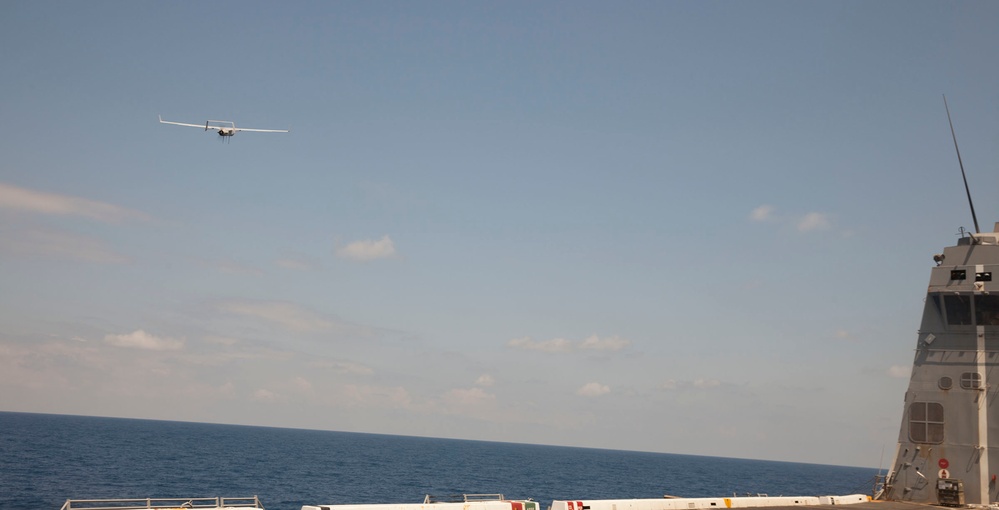
For years, analysts have speculated about what China intended to do with the Type 076, a new class of large amphibious warship that looked, in early satellite imagery, like something more ambitious than a conventional helicopter carrier. Newly released close-up footage has now settled much of that debate. The lead ship of the class, Sichuan, is fitted with an electromagnetic catapult and arresting gear near the stern — hardware arrangement that, according to a technical assessment by Janes, makes it the world's first amphibious assault ship to combine catapult launch and arrested recovery for fixed-wing aircraft. And the aircraft it appears built to launch are not manned fighters. They are drones.
The footage, first published on July 10 by China National Radio and analyzed in a July 16 report by Janes, offers the clearest look yet at the ship's flight deck. It shows deck markings, an electromagnetic catapult, and an arrested-recovery system positioned toward the stern. Crucially, the markings are laid out for fixed-wing uncrewed aerial vehicles — there are no rotor-wing markings, such as the tail clearance lines you would expect on a ship built primarily around helicopters. Taken together, the details point to a vessel designed from the outset as a seagoing platform for launching and recovering combat drones.
What the Footage Actually Shows
Sichuan is the first of the Type 076 class built for the People's Liberation Army Navy (PLAN). Janes estimates the ship displaces between 40,000 and 50,000 tonnes and runs at least 250 meters in length — figures that put it well above a typical amphibious assault ship and into territory that overlaps with light carriers. It retains the core feature that defines an amphibious warfare vessel: a floodable well deck for embarked marines, allowing it to launch landing craft and support a beach assault in the traditional sense.
What sets it apart is the pairing of that well deck with a full launch-and-recovery system for fixed-wing aircraft. The electromagnetic catapult — the same category of technology the U.S. Navy uses on its newest Gerald R. Ford-class supercarriers — allows heavier aircraft to be flung off a short deck at flying speed, while the arresting gear at the stern lets fixed-wing aircraft land back aboard. No current amphibious assault ship in service anywhere has combined all three elements: well deck, EM catapult, and arrested recovery.
The ship was launched in December 2024 at the Hudong-Zhonghua Shipbuilding facility, and Janes reports it is expected to be delivered to the PLAN within a year. The technical read carries the byline of Ridzwan Rahmat of Janes, whose reporting forms the authoritative basis for the hardware claims here.
Why a Catapult on an Amphib Is Such a Big Deal
To understand why this matters, it helps to separate two things that usually travel together on a warship: how aircraft get airborne, and what kind of aircraft they are.
Most amphibious assault ships in service today — including the U.S. Navy's Wasp- and America-class ships — operate helicopters and short-takeoff/vertical-landing jets like the F-35B. Those aircraft don't need a catapult; they use the deck as a runway or lift off vertically. That flexibility comes at a cost. STOVL and rotary designs sacrifice range, payload, or endurance compared with a conventional fixed-wing aircraft that can use a catapult to get off the deck fully loaded.
By fitting Sichuan with a catapult and arresting gear, China is signaling that it wants to operate a different class of aircraft from an amphibious hull — heavier, longer-ranged, fixed-wing designs that would otherwise need a full-size aircraft carrier. And because the deck markings point specifically to UAVs rather than manned jets, the most likely payload is a mix of fixed-wing combat and reconnaissance drones. That effectively turns an amphibious warship into a drone carrier without giving up its ability to put marines ashore.
A Dedicated Drone Carrier for the Amphibious Task Group
Army Recognition, in a July 17 assessment, framed the strategic significance bluntly: Sichuan introduces a capability that no current U.S. or NATO amphibious assault ship possesses. It combines traditional landing and well-deck functions with electromagnetic catapults and arresting gear to launch and recover fixed-wing combat drones. Rather than relying exclusively on traditional aircraft carriers to project airpower, Army Recognition notes, the PLAN could distribute unmanned aviation across multiple amphibious task groups — complicating an adversary's targeting while expanding surveillance and strike coverage over vast maritime areas.
That idea — distributed airpower — is the key to the concept. Rather than concentrating all fixed-wing aviation aboard a handful of large, expensive, high-value aircraft carriers, a Type 076 lets an amphibious group generate its own organic fixed-wing air support: strike, surveillance, and potentially electronic-warfare drones launched and recovered close to where marines are operating. In a contested amphibious operation, that means persistent overhead coverage and reconnaissance without waiting on aircraft flown in from a carrier that may be hundreds of miles away.
It also changes the math on attrition. Drones are, by design, more expendable than crewed aircraft. A ship built to catapult and recover fixed-wing UAVs at scale can absorb losses in a way a carrier air wing of manned jets cannot, and it can do so from a hull that is cheaper to build and field than a full aircraft carrier.
The Logistics Behind the Air Wing
An air wing — crewed or uncrewed — is only as sustainable as the fuel, munitions, and spare parts feeding it. Reporting from The War Zone situates the Type 076 within China's broader carrier and logistics buildup, noting that Sichuan is expected to carry a substantial air wing and that the PLAN is simultaneously constructing a very large new at-sea replenishment ship — described as the largest naval resupply ship in the world — designed to sustain carrier and amphibious groups at sea.
That context matters because a drone carrier that has to return to port every few days to rearm is far less threatening than one backed by an at-sea replenishment train capable of keeping it — and the amphibious group around it — supplied on extended deployments. The War Zone's reporting, by Joseph Trevithick, points to a Chinese navy that is building not just the platforms but the surface logistics tail to keep those platforms operating far from home waters.
Why It Matters
Sichuan represents a genuine first, not an incremental upgrade. According to Janes, no amphibious assault ship anywhere has previously fielded both an electromagnetic catapult and an arrested-recovery system, and the deck layout indicates the ship is optimized for fixed-wing drones rather than helicopters or STOVL jets. That combination hands the PLAN a capability that, as Army Recognition notes, no U.S. or NATO amphibious ship currently matches.
The practical consequence is that China can put organic, catapult-launched fixed-wing airpower into an amphibious task group without committing a full aircraft carrier to the job — and it can do so with attritable drones rather than scarce crewed jets. For Western planners accustomed to a world in which fixed-wing carrier aviation is the exclusive province of large, expensive flattops, the Type 076 collapses part of that distinction. It suggests a future in which amphibious warfare and carrier-style fixed-wing air operations are no longer cleanly separate, and in which uncrewed aircraft — not manned fighters — are the aircraft a warship is built around.
With delivery to the PLAN expected within a year and a supporting logistics fleet already taking shape, the questions now shift from whether China can build such a ship to how it intends to use it — and how quickly Western navies will feel pressure to answer with amphibious drone-carrier concepts of their own.
Sources
- Type 076 footage offers clearest glimpse yet of China's UAV carrier ambitions — Janes (16 Jul 2026), Ridzwan Rahmat
- China's Type 076 First to Catapult-Launch Combat Drones Ahead of U.S. and NATO — Army Recognition (17 Jul 2026)
- China Is Building A Monster Supply Ship For Its Carrier Groups — The War Zone (14 Jul 2026), Joseph Trevithick