
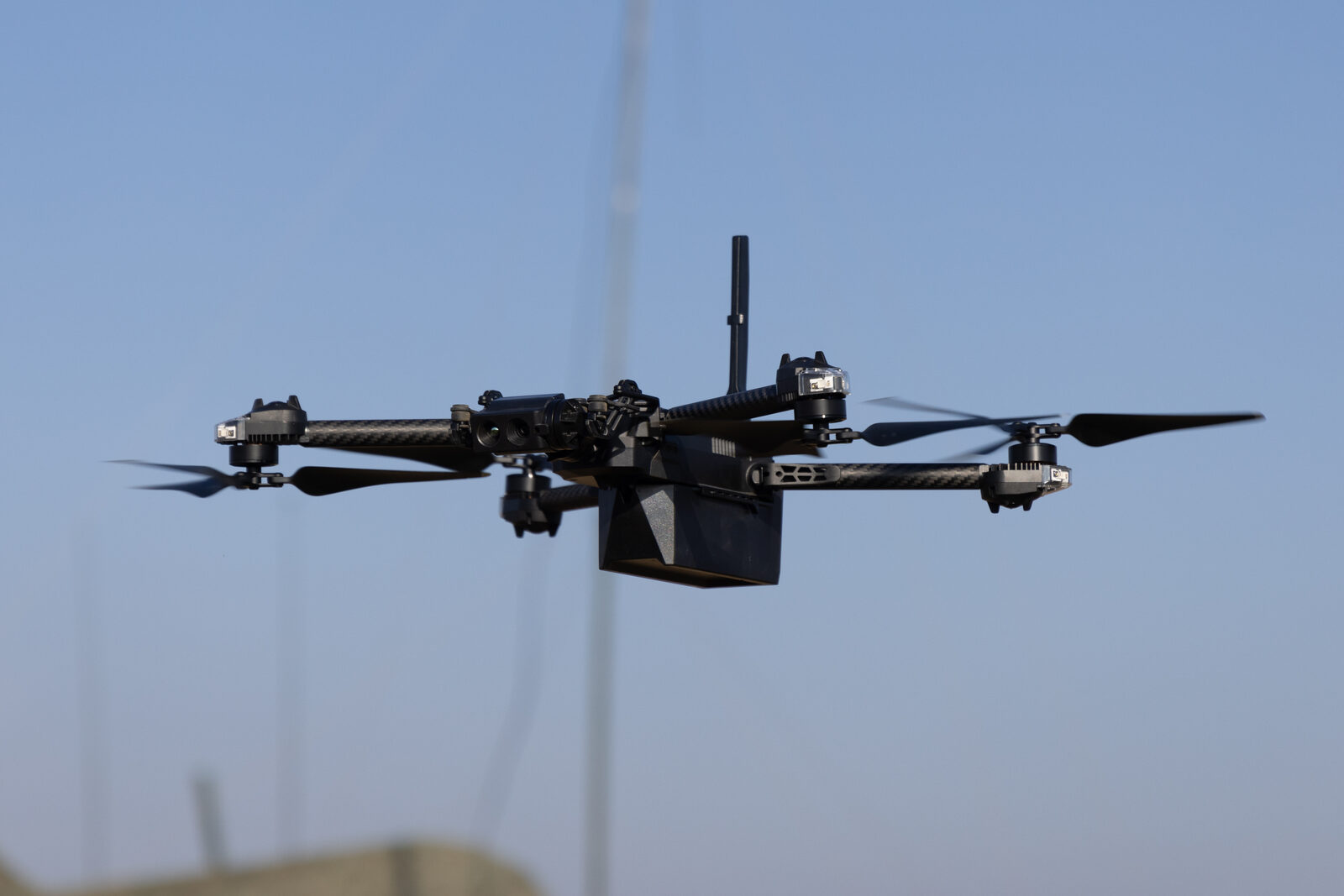
Four months after Orlando City Council signed off on a $6.83 million contract amendment, the Orlando Police Department activated its Drone as First Responder (DFR) network on June 17, 2026. Eleven Skydio X10 aircraft now sit in nine rooftop docking stations strung from downtown Orlando through the Lake Nona district, making OPD the largest U.S. city operating a multi-dock Skydio DFR network as of 2026.
The program runs through Axon Enterprises as prime contractor, with the Skydio X10 — a U.S.-manufactured, sub-6-pound platform capable of autonomous dock-to-scene flight under FAA operational approval (BVLOS waivers are issued per operator, not as a platform rating) — as the airframe. At $759,322 per year over an initial four-year term (with a five-year renewal option), the cost works out to roughly $69,000 per drone per year, inclusive of docks, software integration, and Axon's backend infrastructure.
From a Single Dock to a City Grid
The network did not materialize from a slide deck. OPD ran a seven-week pilot at department headquarters using a single drone before bringing the expansion to council. That trial logged 185 calls and produced two numbers that drove the approval: a 33 percent first-on-scene rate — the drone beat every responding patrol unit on one in three dispatches — and a 97 percent useful-information rate, meaning aerial intelligence was operationally actionable in virtually every flight.
Those figures are notable because they come from real dispatch loads, not a controlled demonstration. A single aircraft at a fixed point reaching scene faster than mobile patrol on a third of calls directly challenged the assumption that ground response times are the irreducible floor for first-contact information. The 97 percent figure is harder to dismiss than the 33 percent: it means the drone almost never generated a wasted flight, which is the practical metric that determines whether an aviation program sustains political support through a city budget cycle.
Council approved contract amendment C25-0282 on February 23, 2026, expanding the city's existing Axon relationship to cover the full eleven-drone buildout. Activation followed on June 17 — a gap of roughly sixteen weeks from vote to operational network across a mid-sized American city, which is fast by municipal procurement standards.
How Dispatch Triggers a Launch
The operational model is category-gated rather than patrol-continuous. Qualifying 911 call types — life-threatening situations, in-progress violent crimes, major property damage, traffic crashes with injuries, and other time-sensitive emergencies — automatically trigger a launch from the nearest available dock. The Skydio X10 then streams live video simultaneously to the OPD Crime Center and to patrol units while they are still in transit.
Target response time is under three minutes from dispatch trigger to drone on scene. The Axon software layer ties drone feeds directly into OPD's body camera system and 911 computer-aided dispatch (CAD), so officers approaching a scene can pull aerial context on the same devices they already carry. The integration also means drone footage is automatically logged alongside other Axon evidence, which matters both for chain-of-custody and for after-action review.
OPD has stated the drones will respond only to the defined emergency call categories, not conduct unprompted patrols — a policy framing consistent with Florida state privacy law and one that was almost certainly necessary to clear council. A federally licensed, sworn OPD officer serves as pilot-in-command from the crime center, monitoring and retaining authority over each flight, while the drone flies autonomously between waypoints with onboard obstacle avoidance.
What It Means for the DFR Market
The Orlando deployment is a reference data point the domestic DFR industry has been waiting for. Skydio is the leading U.S.-manufactured drone platform in the law enforcement segment, and the company's DFR product line has been building a case-study library one city at a time. A multi-dock, nine-station network in a city of roughly 320,000 people — covering a geographic spread from a dense urban core to a master-planned suburban district — is meaningfully different in complexity from a single-dock proof of concept at a police compound.
For Axon, the Orlando contract is also a demonstration that the company's expansion from body cameras and Tasers into airborne ISR is producing real deployments. The Axon-Skydio integration positions Axon as a single-vendor public safety platform that spans wearable sensors, in-car systems, CAD, and autonomous air. That bundling logic is what drives large multi-year amendments to existing contracts rather than competitive re-bids — Orlando's DFR deal was layered onto a pre-existing Axon relationship, not awarded from scratch.
A drone arrived before patrol officers on one-third of calls and delivered useful information on 97 percent of flights — figures drawn from OPD's seven-week single-aircraft pilot that underpinned the February council approval.
The broader DFR sector is watching Orlando partly because of scale and partly because of procurement transparency. The contract amendment, agenda item C25-0282, is on the public record through the city's official meeting portal, providing a clear cost and term structure that other municipalities can benchmark. At $6.83 million over eight years for eleven drones and nine docks, the per-unit economics are visible in a way that opaque government contracts rarely allow.
Whether the 33 percent first-on-scene rate holds as the network scales from a single HQ dock to nine distributed stations across a varied urban geography remains the open question. The pilot was constrained to calls within range of one fixed point; the live network will test whether autonomous routing across a multi-node grid maintains that performance against a real dispatch mix spread across a much larger area.
Why It Matters
DFR programs have proliferated in mid-size U.S. cities over the past two years, but most operate a handful of drones from one or two locations. Orlando's nine-station grid is an architectural step up — a distributed network with enough nodes that coverage gaps shrink and average launch distance to any given address compresses significantly. If OPD's operational data from the live network tracks with the pilot's 33 and 97 percent figures, it will constitute the most substantive public-safety performance dataset for autonomous drone dispatch at city scale to date, and it will be difficult for other major U.S. cities to ignore the procurement case that follows.
For the domestic drone manufacturing argument, the deployment also carries symbolic weight. The Skydio X10 is an American-made platform, and Orlando's contract sits inside a period of heightened federal scrutiny of Chinese-manufactured UAS in law enforcement. The city's decision to route $6.83 million through an Axon-Skydio stack — rather than a DJI or other foreign-made alternative — will be cited in that policy debate regardless of whether OPD intended it as a statement.
Sources
- City of Orlando (orlando.gov) — OPD 21st Century Tools and Technology
- City of Orlando Official Meeting Portal — Council agenda item C25-0282, $6.83M Axon/Skydio DFR contract approval
- DroneXL — Orlando Police Launch 11-Drone Skydio DFR Network (June 20, 2026)
- Orlando Weekly — Orlando City Council to vote on $6.8M police drone program Monday (February 2026)
- FL Voice News — No longer just in movies: Orlando Police roll out automated drone response system (June 2026)