The Air Force's first Collaborative Combat Aircraft now have names. What they do not yet have, according to one of the two manufacturers, is a budget that lets the factory line start moving.
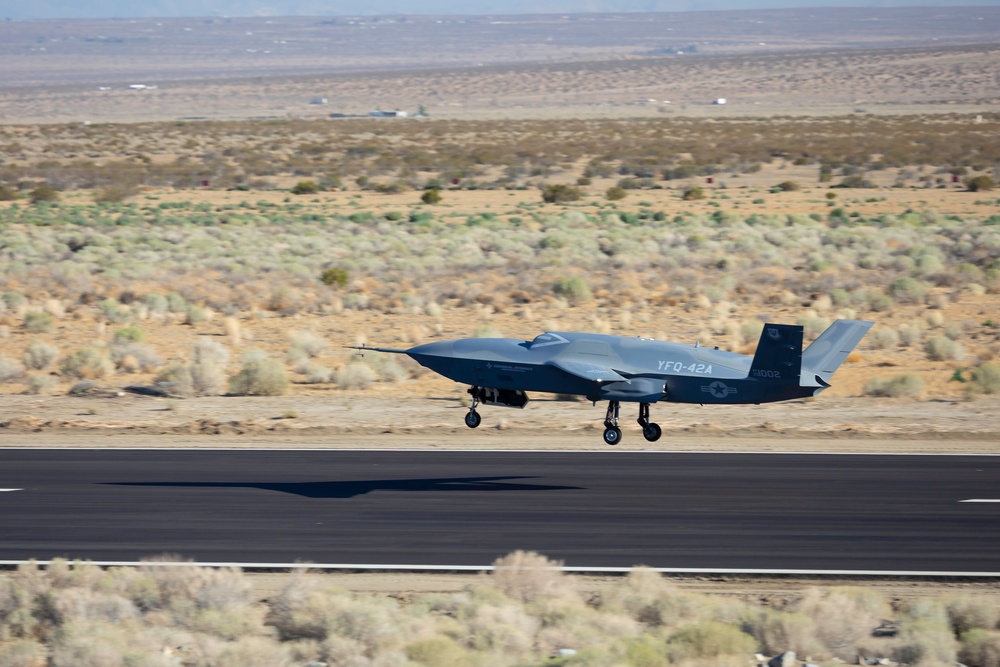
On Sept. 14, Secretary of the Air Force Troy Meink announced during his keynote at the Air & Space Forces Association's Air, Space and Cyber Conference at National Harbor, Md., that the General Atomics FQ-42 will be called Vengeance and the Anduril FQ-44 will be called Fury. The next day, Anduril executives told Breaking Defense that the company cannot begin production under its CCA contract without FY27 procurement dollars. The two messages arrived within roughly 24 hours of each other, and together they describe a program that is moving fast on the flight line and waiting on Congress everywhere else.
What the Air Force Said at AFA
Meink said the service intends to field at least 500 of the autonomous aircraft by 2032, a goal Breaking Defense and The Aviationist both repeat. The production contracts to Anduril and General Atomics were awarded in June 2026, and both aircraft are part of the CCA Increment 1 program.
The test record has moved quickly as well. Breaking Defense reports that the YFQ-44 live-fired an AMRAAM air-to-air missile in July 2026, and both Breaking Defense and The Aviationist describe integration work on a broad list of weapons.
The Money Problem
The budget picture is where the celebration runs into arithmetic. According to Breaking Defense, the FY27 defense budget is not expected until December at the earliest. A continuing resolution passed earlier in September funds the government through Dec. 11, 2026, and restricts the Defense Department's ability to start work on new programs. The new fiscal year begins Oct. 1, so the program will spend at least the first part of FY27 under those restrictions.
Erin Simpson, an Anduril vice president, told the publication that the company will not be starting from zero in 2027: "We will not have a cold start to start production in [20]27. We will have assets rolling through." She added a caveat that amounts to the heart of the story: "Even a company like ours can only do so much without procurement dollars."
Anduril paid for its Arsenal-1 facility near Columbus, Ohio, itself, along with long-lead items, and Breaking Defense reports the plant can produce as many as 150 Furys per year. Breaking Defense also says the quantities under the June contracts have not been disclosed by either company or the Air Force.
Capacity Is Not an Order
Readers should not confuse a factory's capacity with a purchase. Anduril's figure of about 150 Furys per year describes what one company's plant could build in twelve months. It says nothing about how many aircraft the Air Force has actually ordered from Anduril, and the sources reviewed do not establish that number for either vendor.
FlightGlobal adds another wrinkle. Its Sept. 16 report describes an initial planned buy of 500 uncrewed fighters, with Anduril's FQ-44 Fury and General Atomics' FQ-42 competing for quantities. Officials, it says, are "waiting to see how the jets perform before committing to quantities." That reads as a competitive structure rather than a fixed split, and it means the size of each company's eventual order remains open. That piece was only partly accessible for this article, so it is used here for corroboration only.
Fury Gets More Weapons
While the budget argument played out, The Aviationist reported on Sept. 16 on fit checks of Fury with air-to-ground weapons. The checks covered the GBU-54 Laser JDAM, GBU-39/B Small Diameter Bombs, LAU-131A/A pods carrying APKWS rockets, 2.75-inch rocket pods, external targeting pods and low-cost cruise missiles.
Breaking Defense separately lists the weapons integration effort as covering AMRAAM, 500-lb guided bombs, Small Diameter Bombs and the Barracuda 500 cruise missile, along with rocket pods and targeting pods.
The hardware detail matters. The YFQ-44A demonstrator has two external hardpoints, according to The Aviationist. The production FQ-44 has four external hardpoints and can carry four AIM-120s. The Aviationist also notes that the air-to-ground weapons have not yet undergone flight testing or live-release trials. The fit checks, in other words, show what fits, not what has been flown and released.
The same article recounts a July 2026 formation flight between the YFQ-44 and an F-35A at Creech Air Force Base, Nev. The F-35 pilots did not control the drone. FlightGlobal likewise says an Anduril prototype was delivered to an experimental USAF squadron and flew with an F-35 in July.
Why It Matters
Anduril's position is a reversal of the usual defense-industrial story. The company built a factory with its own money, and now the government's calendar is the constraint. A continuing resolution that restricts new-start work does not cancel a program, but it can get in the way of the kind of production ramp that a plant able to build 150 aircraft a year is meant to serve. Simpson's language, that Anduril will not have a "cold start" but that there is only so much a company can do without procurement dollars, reads as a careful way of saying the plant can run on company capital for a while and not indefinitely.
The numbers also matter to the Air Force's argument. The service's case for CCAs rests on fielding at least 500 aircraft by 2032 at low unit cost. The Aviationist reports the unit cost is expected to remain below $20 million. In the sources reviewed, that figure appears only there, and the quantities behind it are still unsettled, so it should be read as a target, not a price. If production stalls or quantities shrink, the cost logic weakens with them.
Finally, the competitive structure gives the delay a second edge. With officials waiting to see how the aircraft perform before committing to quantities, and with two vendors competing for shares of the buy, a company that cannot start building cannot easily demonstrate the production readiness that supports a larger allocation. The reporting does not say that has happened, and Anduril's stated position is that assets will keep rolling through. But the exposure is clear.
What to Watch
- The FY27 budget timeline. Breaking Defense reports it is not expected until December at the earliest, with the continuing resolution running to Dec. 11.
- Disclosed contract quantities. Neither company nor the Air Force has disclosed how many aircraft the June production contracts cover, or how they are split between Vengeance and Fury.
- Live-flight weapons demonstrations. So far the reported air-to-ground work is fit checks; The Aviationist says flight testing and live release have not yet occurred.
- Quantity decisions. FlightGlobal reports officials are waiting on performance before committing to how many of each aircraft to buy.
Sources
- Air Force dubs Collaborative Combat Aircraft FQ-42 Vengeance, FQ-44 Fury | U.S. Air Force (Sept. 14, 2026)
- U.S. Air Force Names CCAs as FQ-42 "Vengeance" and FQ-44 "Fury" | The Aviationist (Sept. 14, 2026)
- Anduril officials say company can't start on CCA production contract without FY27 budget | Breaking Defense (Sept. 15, 2026)
- Anduril's YFQ-44A Fury Expands Its Weapons Options With Air-to-Ground Munitions | The Aviationist (Sept. 16, 2026)
- USAF plans initial buy of 500 uncrewed fighters, Anduril and General Atomics to compete for quantities | FlightGlobal (Sept. 16, 2026)